
Connecting a Legrand push button seems simple on a diagram. Two terminals, one wire coming in, one wire going out. The difficulty arises as soon as you open the flush-mounted box: the colors of electrical wires do not always match the theoretical code, especially in renovations. This article analyzes the discrepancies between the NF C 15-100 standard and the reality on the ground, then details the actual connection on a circuit with a relay switch.
Wire color code: NF C 15-100 standard and discrepancies in renovations
The NF C 15-100 standard establishes a color code to identify the function of each conductor. This code remains the reference for any new installation. In renovations, the colors found in flush-mounted boxes may diverge.
| Function of the wire | Standard color (new) | Common colors in renovation |
|---|---|---|
| Phase | Red, brown, or black | Red, black, sometimes gray or purple |
| Neutral | Blue | Blue (rarely anything else) |
| Earth | Green/yellow | Green/yellow (rarely absent) |
| Return lamp / traveler | Orange, purple, brown (any color except blue and green/yellow) | Orange, purple, black, brown |
Blue is reserved for neutral and green/yellow for earth, regardless of the age of the installation. These are the only two absolute certainties. For all other conductors, the color may vary from one home to another.
Obtaining a compliant lighting with Maison Pro requires checking the actual function of each wire before connection, not just its color.
The recommended practice in renovations is to photograph and label the conductors before any removal, then temporarily label the wires when the colors do not follow the current standard. A simple colored adhesive tape on each conductor prevents mix-ups during reconnection.
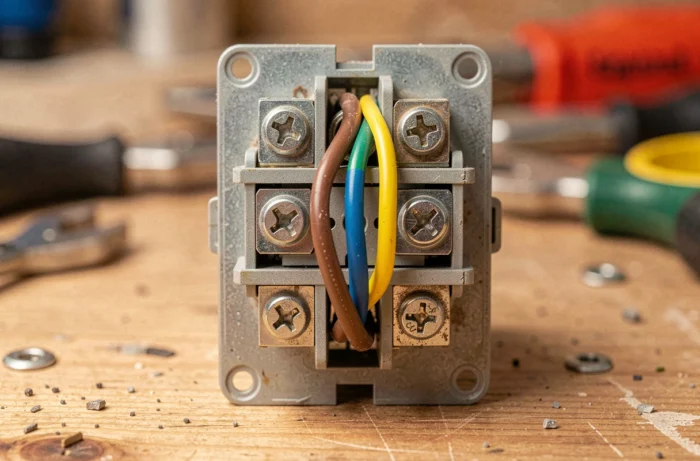
Terminals of the Legrand push button: which wire on which terminal
A Legrand push button has two terminals. The mechanism is a momentary contact: it sends a pulse when pressed, then cuts the circuit when released. It does not maintain the current like a traditional switch.
Connection on a relay switch circuit
The push button does not directly control the lamp. It sends a pulse to the coil of the relay switch (terminals A1 and A2 at the panel), which then switches the power supply contact for the lighting. At the push button, the two connected wires are:
- A phase wire (red, brown, or black in new installations) on the first terminal, which brings current from the circuit breaker through the relay switch
- A return wire from the button (most often orange or purple) on the second terminal, which goes back to terminal A1 of the relay switch coil
No neutral wire is connected directly to the push button. The neutral passes through terminal A2 of the relay switch, at the electrical panel. This is a point that generates confusion: the push button only receives two active conductors, never the blue.
The neutral trap in the flush-mounted box
In some setups, a neutral wire passes through the flush-mounted box of the push button without being connected. It is simply waiting or powering another circuit. Connecting this neutral to a terminal of the push button would cause a short circuit on the first pulse.
To check the function of a wire whose color is ambiguous, a multimeter in voltmeter mode between the suspect wire and earth gives a voltage close to zero for a neutral, and a voltage near the mains voltage for a phase or a live return.
Common wiring errors on Legrand push buttons
DIY forums and field feedback highlight recurring errors. Three of them deserve special attention because they do not always trigger the circuit breaker, making them invisible on the first try.
- Reversing the phase wire and the lamp return wire on the push button: the circuit appears to work, but the relay switch receives the phase continuously on A1 instead of receiving a pulse. The coil overheats continuously and eventually fails
- Using a two-way switch instead of a push button: the lighting remains stuck in one state (on or off) after the first switch, as the two-way switch maintains contact instead of sending a pulse
- Connecting two push buttons in series instead of wiring them in parallel: multiple push buttons must be connected in parallel so that each can independently send a pulse to the relay switch
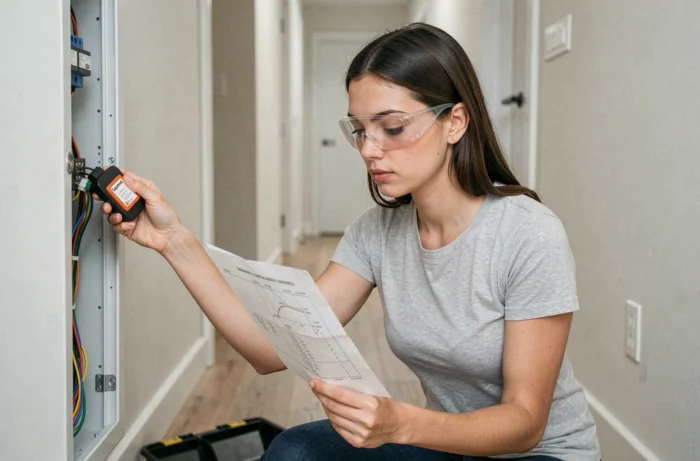
Verification after connection: circuit control points
Once the Legrand push button is connected, three checks allow for validating the connection before closing the flush-mounted box.
The first is to restore power to the circuit breaker and press the push button. The lighting should change state (on/off) with each pulse. If the lamp lights up but does not turn off, the problem lies with the relay switch or a series wiring instead of parallel.
The second check concerns the absence of residual voltage. With the push button released, no voltage should be measurable between the two terminals of the push button. A permanent voltage indicates that the phase is arriving at both terminals, a sign of a wiring error upstream.
The third concerns the continuity of earth. The green/yellow wire must be connected to the earth terminal of the metallic flush-mounted box if the installation includes one. On plastic boxes, the earth is not connected to the push button itself but must remain available in the box for potential future additions.
The connection of a Legrand push button consists of two wires and two terminals. The real difficulty lies upstream: identifying the actual function of each conductor, particularly in older installations where the color code has not been followed. Photographing, labeling, measuring with a multimeter before touching the terminals – this method separates a reliable connection from a repair that needs to be redone.