
The ordinary securities account (CTO) is an account dedicated to holding securities, with no deposit ceiling or restrictions on the investment universe. At Crédit Agricole, it operates as an open envelope for any individual or legal entity, linked to a cash account that records the flows related to stock orders.
Mechanism of the cash account linked to the Crédit Agricole CTO
A point often misunderstood: the CTO does not operate alone. It is systematically coupled with a dedicated cash account that serves as a transit for each transaction. When purchasing shares, the amount is debited from this cash account. When selling, the proceeds are credited to it before a possible transfer to the current account.
This mechanism has a direct practical consequence. Before placing a buy order, the balance of the cash account must cover the transaction amount, including brokerage fees. Without sufficient funds, the order is rejected.
To understand how an ordinary securities account at Crédit Agricole works in detail, the question of repatriating funds to a traditional bank account deserves particular attention, as the timelines vary depending on the type of securities sold.
Dividends received on shares held also land in this cash account. They remain available for reinvestment or withdrawal, without any holding duration constraints.

Eligible securities and stock orders on a CTO
The structural difference between the CTO and the PEA lies in the investment universe. The PEA is limited to European stocks and certain eligible funds. The ordinary securities account, on the other hand, provides access to international markets without geographical restrictions.
On a Crédit Agricole CTO, the categories of accessible financial products cover a wide spectrum:
- Stocks listed on European, American, and Asian exchanges, without nationality filters
- Government or corporate bonds, including those on foreign markets
- Mutual funds, ETFs (trackers), warrants, and derivatives according to the subscribed service agreements
- Subscription rights and investment certificates during securities operations
To place orders, Crédit Agricole provides the Invest Store platform, accessible from the online customer area. It allows for entering different types of orders: market, limit, threshold, or trigger range. The choice of order type influences the execution price and the completion time.
Market orders and limit orders
A market order is executed at the best available price, with no price guarantee. It is suitable for highly liquid securities where the spread between supply and demand remains low.
A limit order sets a maximum price for buying or a minimum price for selling. It protects against sudden fluctuations but may remain unexecuted if the price never reaches the set limit. For less traded securities, this precaution avoids unpleasant surprises.
Taxation of the ordinary securities account in 2026
Income and capital gains realized on an ordinary securities account are subject by default to the flat tax (PFU), which combines income tax and social contributions.
A technical point to remember: the option for the progressive scale is global. It applies to all income from movable capital and capital gains from securities sales for the relevant year. It is not possible to choose the PFU for dividends and the scale for capital gains, or vice versa.
Carryforward of capital losses on a CTO
Capital losses realized upon the sale of securities do not reduce the overall taxable income (salaries, pensions). They can only offset capital gains of the same nature, first those of the current year, then those of the following ten years.
This ten-year carryforward mechanism requires rigorous tracking. Each year, during the tax declaration, the balance of unutilized capital losses must be reported. An oversight can result in losing the benefit of this carryforward.
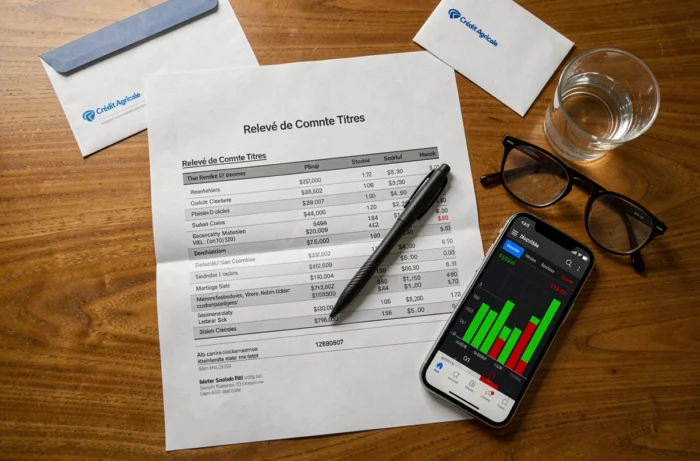
Fees and daily management of the Crédit Agricole CTO
The fees applied to a CTO vary depending on the regional Crédit Agricole branch. This point is often underestimated: two clients residing in different regions may pay different custody fees or brokerage commissions for the same transaction.
The main fee items to watch out for:
- Annual custody fees, calculated as a percentage of the portfolio valuation or per line of securities held
- Brokerage commissions charged for each executed order, sometimes with a minimum per transaction
- Specific fees for transactions on foreign markets, generally higher than on Euronext Paris
Using the Invest Store platform for self-management means that the account holder makes their own investment decisions. Crédit Agricole also offers managed investment options, where a manager handles allocations according to a defined risk profile at the opening. Management fees for managed accounts are added to brokerage fees.
The CTO at Crédit Agricole remains an envelope without a ceiling or minimum holding period, which gives it a flexibility that the PEA cannot offer. The trade-off lies in a less favorable tax treatment on long-term capital gains, a consideration that each investor must evaluate according to their investment horizon and the geographical composition of their portfolio.