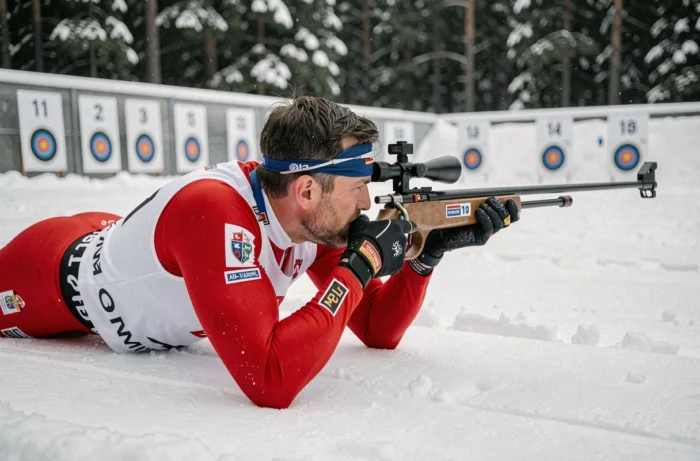
Biathlon combines two opposing disciplines: cross-country skiing, an endurance effort with high cardiac intensity, and rifle shooting, which requires total control of breathing rhythm and heart rate. Following the results daily requires understanding how race formats, ranking systems, and regulatory changes directly influence the displayed performances.
Biathlon Race Formats and Result Interpretation
Before consulting a results table, it is essential to distinguish the formats that structure each stage of the World Cup. Each format produces a different type of ranking, and time differences are not interpreted the same way.
The sprint is the reference race. Men cover 10 km, while women cover 7.5 km, with two shooting rounds (one prone, one standing). Each missed target adds a penalty loop. The sprint ranking determines the starting order for the pursuit.
The pursuit takes the time gaps from the sprint as the starting point. Men cover 12.5 km, women 10 km, with four shots. The first athlete to cross the finish line wins the race, making the result clearer than in the sprint, where only the stopwatch decides.
The mass start gathers the best from the overall ranking. Everyone starts simultaneously on the same line, with four shots. This format produces the most spectacular finishes and the most volatile results. The relay, mixed or single, adds a collective dimension where each missed shot beyond three spare rounds results in a penalty lap.
To follow biathlon results today, understanding these formats allows for instant decoding of why an athlete excels in the sprint but struggles in the pursuit, or vice versa.
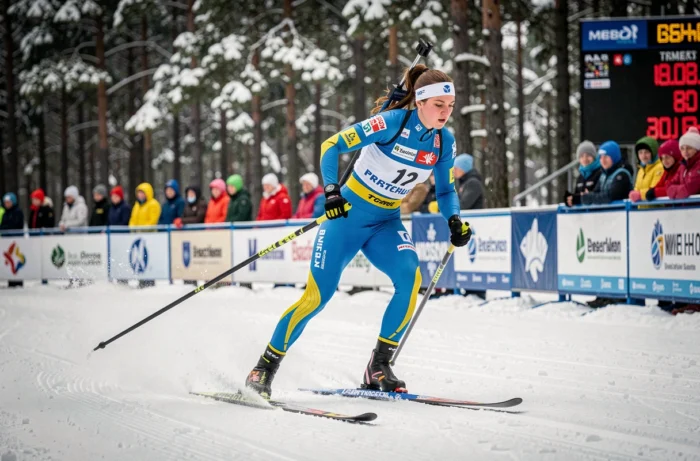
Overall Ranking and Crystal Globe: What Daily Results Feed
Each race awards points for the overall World Cup ranking. The accumulation of these points over the entire season determines the holder of the Crystal Globe, a trophy that rewards consistency over several months of competition.
Specific globes exist for each discipline: sprint, pursuit, mass start, individual. An athlete can dominate the sprint ranking without ever winning the overall globe because their results in pursuit or mass start are too inconsistent.
Why Shooting Weighs Heavily in the Ranking
The penalty loop represents about 150 additional meters to cover. In a sprint, two missed targets can cost a skier the victory, even if they are faster on the track. Shooting accuracy often separates results more than pure skiing speed, especially in windy or extremely cold conditions that characterize certain stages.
Daily results thus reflect a fragile balance between physical condition, stress management, and weather adaptation capacity. A fan who only checks the skiing time misses half of the analysis.
Exclusion of Russian and Belarusian Athletes: Concrete Impact on 2026-2027 Results
The International Biathlon Union officially decided in August 2026 to maintain the exclusion of Russian and Belarusian athletes for the entire 2026-2027 season. Requests for reconsideration were rejected before the September 2026 congress.
This decision has a direct consequence on result interpretation. Several biathletes who regularly ranked in the world top 10 before 2022 are not participating in any World Cup or IBU Cup events. Current rankings do not reflect the full global talent pool.
Unlike other sports, the IBU statutes do not allow participation under a neutral banner. This specificity makes the return of these athletes impossible as long as the union’s policy does not change, regardless of the decisions of the International Olympic Committee.
Ban on Fluorinated Waxes and Disruption of Sports Hierarchy
Live results pages display times without explaining a technical factor that profoundly alters the competition. Fluorinated waxes (PFAS) have been banned in competition since the 2023-2024 season, in accordance with the rules of the International Ski Federation, which biathlon aligns with.
Waxing influences glide and thus skiing time on each timed section. Without fluorinated waxes, technical teams must find alternatives that offer comparable glide performance. Nations with significant research and development budgets maintain an advantage, while smaller teams lose a technological shortcut that was previously accessible.
European PFHxA Restriction Starting October 2026
At the European level, a targeted restriction on the compound PFHxA and related substances will come into effect on October 10, 2026, in all member states. This regulation covers textiles and sports equipment, impacting the material ecosystem of teams well beyond simple waxing.
- Race suits containing PFAS treatments will need to be replaced or certified compliant with the new standards
- Manufacturers of skis and rifles are revising their surface treatment processes to eliminate targeted substances
- National teams must budget for the early renewal of equipment, a cost that widens the gap between large and small federations
Results on the track now also reflect each team’s technological adaptability, not just individual athletic level.
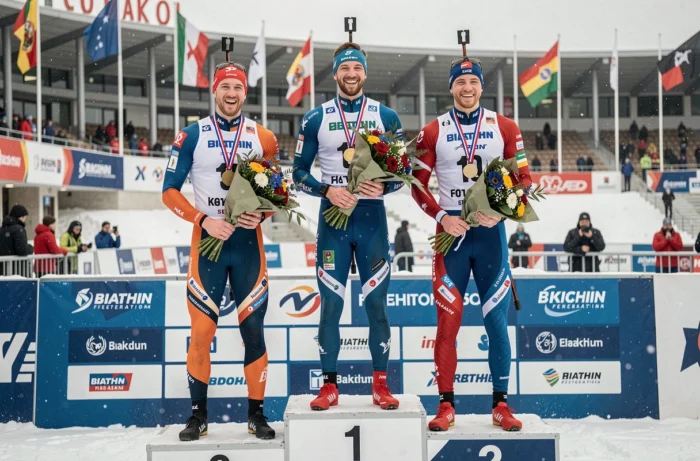
World Cup Schedule: Key Stages to Watch
The World Cup season generally runs from late November to mid-March, with stages spread across Scandinavia, Central Europe, and sometimes North America. Each site imposes specific snow, altitude, and wind conditions that influence results.
- Scandinavian stages (Östersund, Holmenkollen) are characterized by low temperatures and technical tracks
- Alpine stages (Hochfilzen, Anterselva, Le Grand-Bornand) feature more pronounced elevation changes that favor powerful skiers
- Season finals concentrate the stakes of the overall ranking and often produce surprising results under pressure
The IBU Cup and Junior Cup complement the main circuit and serve as a springboard to the World Cup. The results of these secondary circuits help identify future names in biathlon before their breakthrough at the highest level.
The upcoming 2026-2027 season is expected to be marked by the sports and regulatory consequences described above. Following daily results with these frameworks transforms a simple ranking consultation into a true understanding of the discipline.