A wedding is typically planned over twelve to eighteen months. Between choosing the venue, the guest list, and the administrative steps, each decision builds on the previous one. Organizing a successful wedding is primarily about laying the right foundations from the start, then adjusting over the months without losing sight of what matters to both of you.
Publication of the banns and marriage contract: two often underestimated steps
Before thinking about decoration or the wedding dress, there is a mandatory step: the file at the town hall. In France, the publication of the banns must precede the ceremony by at least ten days, according to Service-Public.fr. This timeframe may seem short, but submitting the complete file (identity documents, proof of residence, civil status information of the witnesses) often takes several weeks.
Do you already own real estate, have a self-employed activity, or children from a previous union? The marriage contract is signed before the ceremony at a notary. Without this step, you will automatically be subject to the community of acquired property regime. This regime suits many couples, but it can create delicate situations for entrepreneurs or blended families.
Scheduling a notary appointment three to four months before the big day allows time to compare marital regimes without rushing. By browsing the advice from Esprit Mariage, you will also find useful guidelines to coordinate these legal steps with the rest of the organization.
Wedding budget: distributing the items without getting lost
The budget remains the nerve of the war. Rather than setting a total amount and hoping everything fits, a more reliable method is to identify the three most significant items: the reception venue, the caterer, and the photographer. Together, they usually account for the majority of expenses.
Defining a budget for each item before contacting service providers avoids unpleasant surprises. A simple table with four columns (item, planned budget, received quote, final amount) is enough to keep control month after month.
Financing is also evolving. Couples now take on most of the budget themselves, with parental contributions becoming a global contribution rather than a payment item by item. Clarifying this point with family from the start avoids misunderstandings.
Items where price discrepancies are most marked
- The reception venue: a private estate during peak season can sometimes cost double that of the same space booked on a weekday or outside of summer. Comparing three to five quotes remains the best protection against inflated prices.
- The caterer: the choice between a buffet and a sit-down meal significantly changes the bill, as well as the atmosphere of the evening. A buffet encourages guest mingling, while a seated meal structures the event more.
- Floral decoration: seasonal flowers reduce costs while providing a fresher look. A local florist who works in short supply chains often offers arrangements at better prices than a large workshop.
Guest list and seating plan: two related exercises
Do you think the guest list can be finalized in one evening? In reality, it is one of the longest steps. Each addition modifies the budget, the seating plan, and sometimes the choice of venue. It’s better to start with a realistic target number, then adjust based on confirmations.
A simple tool works well: create two columns, “necessary” and “if the budget allows.” This distinction avoids back-and-forth between the couple and families.
The seating plan, a puzzle with its rules
Placing guests is not just about grouping friends on one side and family on the other. Three principles help to smooth the evening:
- Mix social circles at each table to create new conversations, placing at least one “connector” (a sociable person who puts others at ease) per group of eight.
- Keep people in open conflict apart without creating visible “punitive” tables. Discretion is key.
- Plan a small head table limited to witnesses and close family. An overly large head table ends up isolating the couple from the rest of the room.
Finalizing the seating plan two weeks before the ceremony allows for last-minute cancellations without having to rebuild everything.
Civil ceremony: personalizing the central moment of the wedding
The civil ceremony at the town hall rarely lasts more than twenty minutes. For couples who want a more personal moment, the secular ceremony offers total freedom regarding the location, proceedings, and participants.
Specifically, an officiant (close friend, family member, or professional) conducts the ceremony according to a script that you write together. Readings, exchanging personal vows, symbolic rituals: each element reflects your story rather than an imposed protocol.
Here are a few practical points to anticipate. If the ceremony is held outdoors, plan a backup solution in case of rain. A tent or a room adjacent to the estate is sufficient. Also consider sound: a wireless microphone and a small amplified speaker ensure that guests at the back can hear everything.
Decoration and ambiance: creating visual coherence without overloading
The decoration sets the tone for the day, but it doesn’t need to be spectacular to leave an impression. A clear guiding thread (a palette of two or three colors, a dominant material) unifies everything without multiplying purchases.
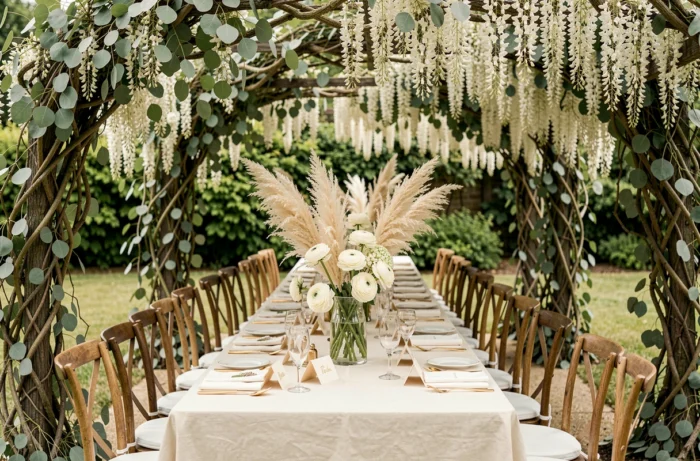
Large centerpieces hinder conversation. Favor low arrangements or slender elements (candles, small vases, foliage) that allow the gaze to flow. Light plays as much a role as flowers: warm bulb garlands or lanterns transform any space at dusk.
Couples opting for an eco-friendly approach often replace disposable tableware with rentals, and plastic confetti with dried petals or seeds to plant. These choices reduce waste without sacrificing aesthetics.
The final detail that makes a difference is the coherence between the stationery (invitations, menus, place cards) and the decoration on the big day. A consistent graphic design across all materials creates a visual identity that guests notice, even subconsciously. It’s this kind of attention that distinguishes a well-crafted wedding from one that is merely well-organized.