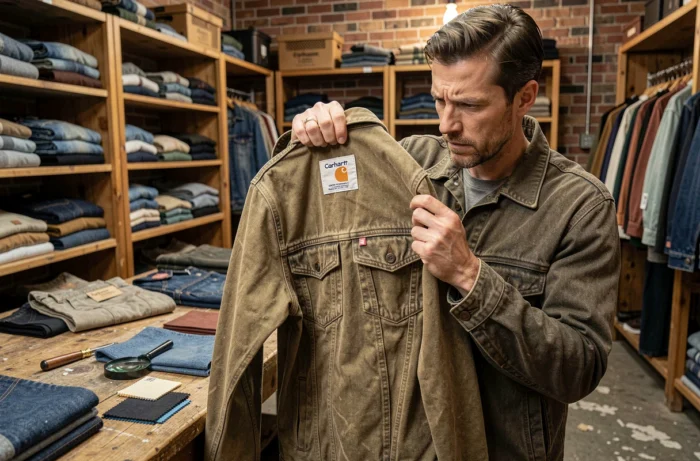
At a flea market or a marketplace, a discounted Carhartt jacket catches the eye. The problem is that counterfeits of this workwear brand, founded in 1889 in Detroit, are circulating massively, especially for the most sought-after models like the Detroit Jacket or the Active Jacket. Recognizing a genuine Carhartt garment requires checking specific details, not relying on a general impression.
1. Check the exact spelling on every label
A fake Carhartt often reveals itself through a spelling mistake on the patch, label, or buttons. The official spelling contains one r after the h and two final t’s: Carhartt. Any variant (Carhart, Carharrt, Carthart) printed somewhere on the garment indicates a counterfeit.
You can find these tips for authenticating Carhartt in most specialized guides, and for good reason: this mistake remains the most common among counterfeiters. Make it a habit to read every inscription letter by letter.
2. Inspect the embroidered “C” logo, not printed
On an authentic Carhartt, the “C” shaped logo is embroidered with neat and consistent thread. A logo that is simply printed and flakes or cracks when touched is a strong warning sign.
The embroidery should have clean edges, with no threads sticking out chaotically. On counterfeits, the shape of the “C” is often slightly distorted or disproportionate compared to the original.
3. Examine the engraved buttons and rivets
The metal buttons on a genuine Carhartt feature the engraving “Carhartt” in relief. On a counterfeit, this inscription is either missing, simply printed on the surface, or engraved poorly with misaligned letters.
Smooth buttons or those without markings are a reliable sign of a fake. Run your finger over the surface: authentic engraving feels distinct to the touch.
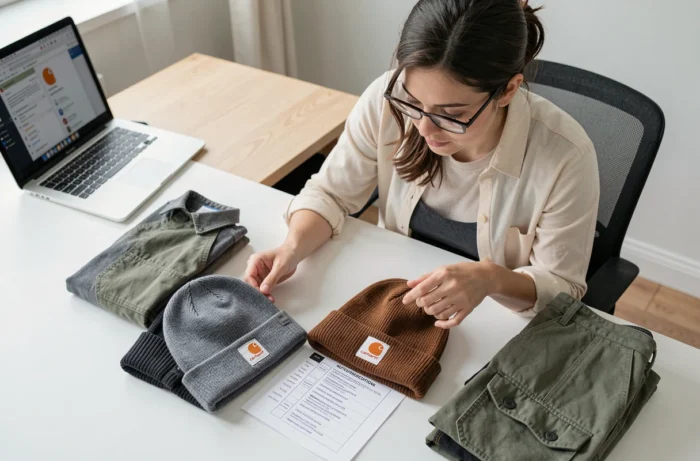
4. Check the holographic strip on the care label
Recent Carhartt garments include a holographic strip on the inner care label. This strip changes its reflection depending on the angle of light and is difficult for counterfeiters to reproduce.
However, be cautious: the absence of a holographic strip does not always prove a fake. It depends on the age of the piece and the model. On vintage items from the 1990s, it will not be found. This criterion should be cross-referenced with others, never used alone.
5. Cross-check the style number on the inner label
Every Carhartt garment carries a code called the “style number” on its inner label. This code identifies the model, color, and sometimes the production season. On a fake, this code is often inconsistent: it does not correspond to any existing model in the Carhartt catalog.
You can verify the consistency by comparing the style number with known references of the model you think you have. A fanciful or absent code quickly settles the debate.
6. Distinguish Carhartt US from Carhartt WIP
Carhartt operates under two distinct entities. Carhartt Inc. produces American workwear. Carhartt Work In Progress (WIP) is the European fashion line, launched in the 1990s under license, focused on streetwear.
Both lines use different labels, cuts, and style codes. Counterfeiters frequently mix labeling elements from both lines on the same garment. Finding a square WIP logo on a piece sold as American workwear, or vice versa, is a reliable counterfeit signal.
7. Assess the quality of double or triple stitching
Carhartt workwear is distinguished by reinforced stitching, double or triple in areas of stress. On an authentic piece, these stitches are regular, well-tensioned, with no looping threads.
- The shoulder and inseam stitches should be perfectly aligned, with no visible offset
- The thread used is thick and durable, often in a matching or deliberately contrasting tone
- The decorative topstitching follows a straight line consistently along its length
A counterfeit typically features irregular stitching, thin threads, or areas where the stitching deviates significantly.
8. Test the thickness and rigidity of the fabric
The duck canvas and denim used by Carhartt have a dense weight, recognizable by touch. The fabric of an authentic jacket has a firm rigidity when new, and aging softens the canvas without thinning it.
A fabric that feels too soft upon first contact should raise alarms. Counterfeits use lighter and less dense fabrics that wrinkle differently and lack stability when laid flat.
9. Verify the consistency of the fit and size label
Carhartt US uses an American sizing system (S, M, L or measurements in inches like W x L for pants). Carhartt WIP uses European sizes. A piece sold as Carhartt US with a European fit on the label poses a consistency issue.
Returns vary on this point depending on production periods, but the general rule remains reliable: the sizing system must correspond to the announced line.
10. Beware of Carhartt Brown that is too bright or too dull
The signature shade “Carhartt Brown,” this characteristic deep ochre, is difficult to reproduce accurately. On counterfeits, the color often leans towards a bright orange or a flat brown, lacking the depth of the original hue.
Comparing with an official photo of the model on the Carhartt website helps spot a color discrepancy. On vintage pieces, natural fading follows a gradual and even pattern. An irregular patchy fade may indicate a lower quality fabric typical of copies.
No single criterion is sufficient to authenticate a Carhartt garment. It is the accumulation of checks, from the spelling on the patch to the fabric density, that allows for a decision. In the second-hand market, taking two minutes to examine these points avoids paying a high price for a copy.