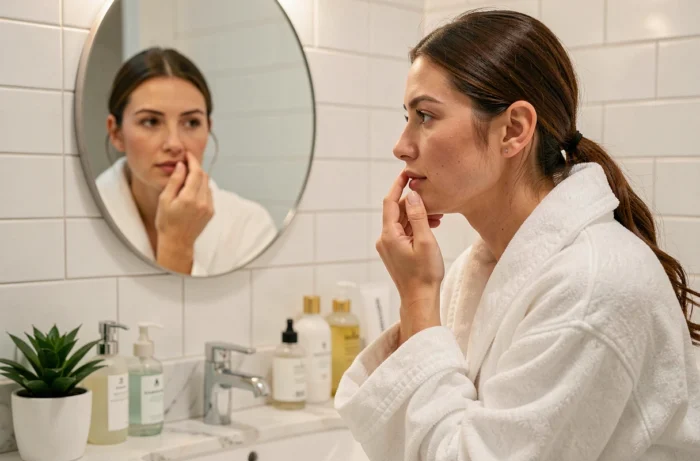
A bottle of serum that stays closed on the shelf, a sunscreen forgotten at the back of the drawer, a cleanser bought on a whim and never finished: we all know this pattern. The problem with a beauty routine is almost never the lack of products, but the difficulty in maintaining regular habits with treatments that truly match our skin.
Beauty routine and microplastics: what the European regulation changes
Before discussing gestures and textures, we must address a point that concretely alters the contents of our bathrooms. The European regulation 2023/2055 gradually restricts the intentionally added microparticles of synthetic polymers in cosmetics. Rinse-off products (some cleansers, exfoliating gels) are subject to an important deadline in October 2027, and several leave-on products have a transitional period extending until 2029.
In practice, this means that some scrubs and cleansers will be reformulated in the coming months. If you have a stock of synthetic microbead exfoliants, check their INCI list. Brands are already reformulating with plant-based alternatives (apricot kernel powder, cellulose), and the textures are slightly changing.
To keep track of these product developments and discover tested alternatives, detailed feedback can be found on lesbabillagesdebabinette.com, particularly regarding the textures and composition of everyday care products.
This regulatory point is not trivial: it directly impacts routines built around mechanical cleansing. It’s better to anticipate than to find yourself with a product withdrawn from the market without a replacement solution.

Facial cleansing morning and night: adapting the gesture to reality
We read everywhere that we should cleanse morning and night. The advice is correct, but the way to do it makes all the difference. In the morning, the skin is not dirty in the strict sense: it has produced sebum and accumulated a bit of sweat overnight.
A gentle cleanser or even a floral water is sufficient. Using an aggressive foaming cleanser at 7 a.m. on skin that hasn’t been exposed to pollution is just stimulating sebum production for no reason.
In the evening, it’s different. Makeup, sunscreen, fine particles: double cleansing is truly beneficial in the evening, first with an oil-based product (oil, balm) to dissolve makeup, followed by a water-based cleanser to finish.
When double cleansing becomes counterproductive
On dry or reactive skin, daily double cleansing can weaken the skin barrier. Feedback varies on this point, but a reasonable approach is to reserve double cleansing for days when wearing makeup or water-resistant sunscreen.
On makeup-free days, a single pass with a milk or rinsed micellar water does the job without stripping.
Hydration and facial care: choose less but better
C serum, hyaluronic acid, niacinamide, retinol, peptides: the list of available actives is dizzying. We pile on layers hoping for a cumulative result, and end up irritating our skin or simply not applying anything because the routine takes too long.
Three well-chosen products cover the majority of needs: an appropriate cleanser, a moisturizer with one or two targeted actives, and sun protection in the morning. Everything else is optional.
- If you are targeting radiance and spots, a vitamin C serum in the morning under sunscreen shows visible results in a few weeks.
- If the main concern is dehydration, a hyaluronic acid serum applied on damp skin improves water retention in the epidermis.
- If you are looking to smooth skin texture, retinol in the evening (starting with a low concentration, twice a week) remains the most documented active.
Multiplying actives on the same evening increases the risk of irritation without necessarily multiplying the benefits. Introducing only one new active at a time for three weeks allows you to know what really works.

In-store testing and feedback from peers: what really makes a product adopted
A Criteo study reported by La Reclame in August 2026 shows that when choosing a beauty product in France, consumers first mention friends, then in-store trials or samples, and online reviews. Search engines and content creators come after.
This finding changes the way to approach your routine. Reading step-by-step lists online is not enough: testing the texture on your own skin remains the decisive criterion. A product whose formulation is not appealing (too sticky, too thick, unpleasant smell) will be abandoned within a few days, regardless of its composition.
Request samples without hesitation
In salons or pharmacies, samples exist for that purpose. Before investing in a jar of cream, ask for a dose for three or four days of testing. This is particularly useful for facial care products containing retinol or exfoliating acids, as tolerance varies greatly from person to person.
You don’t buy a product just because it has good online ratings. You buy it because you’ve worn it on your skin for a few days and the sensation was pleasant enough to want to continue.
Stable beauty routine or seasonal adjustments: finding the balance
Keeping the same products all year round simplifies life, but the skin does not have the same needs in January and July. In winter, dry air and heating pull on hydration: switch to a richer cream or add a vegetable oil in the evening. In summer, heat and sweating call for lighter textures, a gel or fluid.
Adjusting two products per season is enough without completely overhauling everything. The cleanser and serum can remain the same. It’s the moisturizer and sunscreen (higher SPF in summer, more fluid texture) that deserve a seasonal swap.
The routine that lasts over time is not the one that follows an ideal protocol on paper. It’s the one that takes less than five minutes, uses pleasant textures, and adapts when the skin sends a signal (tightness, shine, redness). Three consistent gestures are worth more than ten sporadic ones.