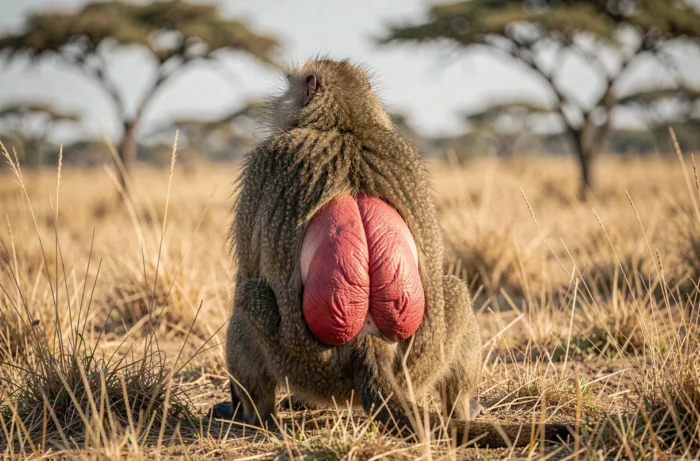
In the field, when observing a group of baboons in East or Southern Africa, the first thing that strikes you is not their cry or agility. It’s that bright red patch on their behind, visible from several dozen meters away. Far from being a mere whim of nature, this coloration serves specific biological functions that research continues to refine.
Baboon Buttock Callosities: A Unique Skin Tissue
Competitors often refer to “red bottoms” as a uniform block. In reality, the colored area corresponds to the ischial callosities, thickened patches of skin located on either side of the pelvis. This tissue, devoid of hair, is supplied by a particularly dense network of blood capillaries.
It is this superficial vascularization that gives the red hue. Blood flows just beneath the skin’s surface, without a layer of fat or fur to soften the color. One can compare the mechanism to that which causes our cheeks to flush, except that here the phenomenon is permanent and structural.
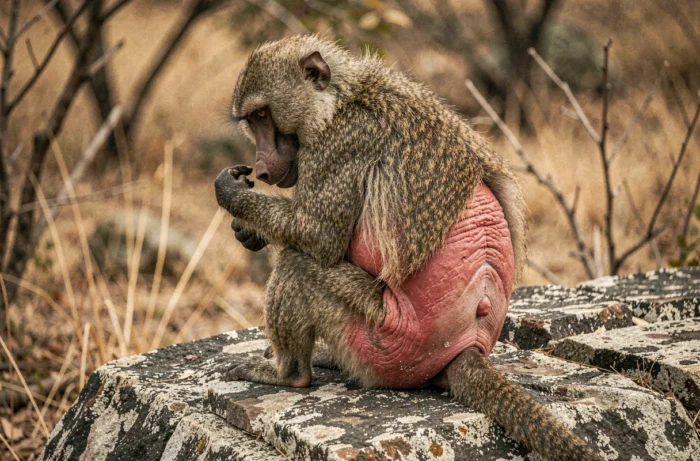
In females, the area is not limited to the callosities. During the fertile period, the perineal skin swells due to estrogen, forming sometimes spectacular tumescence. This swelling amplifies the visible red surface and alters the shape of the behind. To understand the reasons for the baboon’s red bottom, one must distinguish between two overlapping phenomena: the permanent coloration of the callosities and the cyclical swelling related to reproduction.
Fertility Signal in Female Baboons: What the Red Color Communicates
When a female baboon enters the ovulation phase, the perineal tumescence reaches its maximum volume and the redness intensifies. The males in the group spot this visual signal from a distance, well before they can detect pheromones. It is a reliable indicator of the reproductive window.
Research on Guinea baboons (genus Papio) suggests that finer nuances also play a role in reproductive decisions. More intensely red patches on the behind could provide females themselves with information about the quality of potential partners, although this is not the only signal at play.
Hunting Does Not Make the Best Partner
A recent and counterintuitive angle: in Guinea baboons, the ability to hunt or transfer meat does not seem to predict male reproductive success. Females do not necessarily choose the best hunter. This shifts attention to other markers of quality, particularly colorful body signals and overall physical condition.
The red behind then functions as a “visual resume” more reliable than a one-time food exploit. It reflects hormonal state, immune status, and, indirectly, the male’s ability to maintain a high social rank.
Social Hierarchy and Red Color in Male Primates
In male baboons, the coloration of the behind does not fluctuate with a reproductive cycle. It varies with hierarchical rank and physical condition. A dominant, healthy male typically displays a more intense hue than a stressed or sick subordinate.
This link between social status and coloration is even clearer in mandrills, often confused with baboons in popular content. Mandrills are not baboons in the taxonomic sense (they belong to the genus Mandrillus, not Papio). In them, the red color of the behind and muzzle signals both rank and physiological condition, with intensity directly correlated to testosterone levels.
- In the hamadryas baboon (Papio hamadryas), red callosities are present in both sexes, but cyclical swelling remains specific to females.
- In the mandrill, the red coloration also covers the face and intensifies in alpha males, making it a double signal (status and fertility).
- In other primate species like Japanese macaques, facial redness plays a similar role but concerns the face rather than the behind.
Ecological Pressure in Africa: Why the Red Color Is Not a Handicap Against Predators
One might expect such a conspicuous signal to attract predators. Baboons live in environments where leopards, hyenas, and large birds of prey pose real threats. Displaying bright red on their behind seems risky.
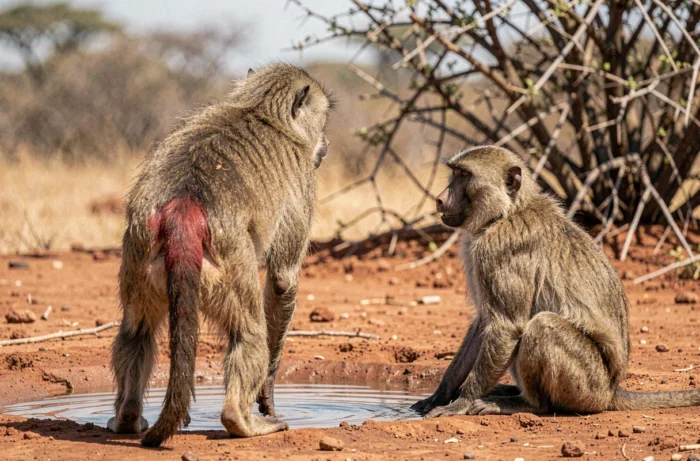
In practice, group living constitutes the first line of defense for baboons. Troops often consist of several dozen individuals, with sentinels and dominant males ensuring collective protection. The cost of the signal (being visible) is offset by the reproductive benefit it provides.
Baboons are also not easy prey. Their size, imposing canines, and coordinated behavior deter most opportunistic predators. The red of the behind does not significantly increase individual risk in a vigilant and structured group.
A Classic Evolutionary Trade-off
This type of trade-off between visibility and reproductive advantage is found in many species. The peacock’s tail, the plumage of birds of paradise, the antlers of deer: all costly traits that persist because they enhance reproductive chances. The red behind of the baboon follows the same logic of sexual selection.
The notable difference in baboons is that the signal concerns both sexes, although its intensity and function vary. Females use it to signal their fertility, while males use it to assert their rank. Data on certain species remain partial, and responses vary according to the studied populations and their habitat.
The red behind of the baboon is neither an accident nor a gratuitous ornament. It is a communication tool shaped by thousands of generations of selective pressure, where each shade of red tells something about the health, status, and reproductive availability of its bearer.