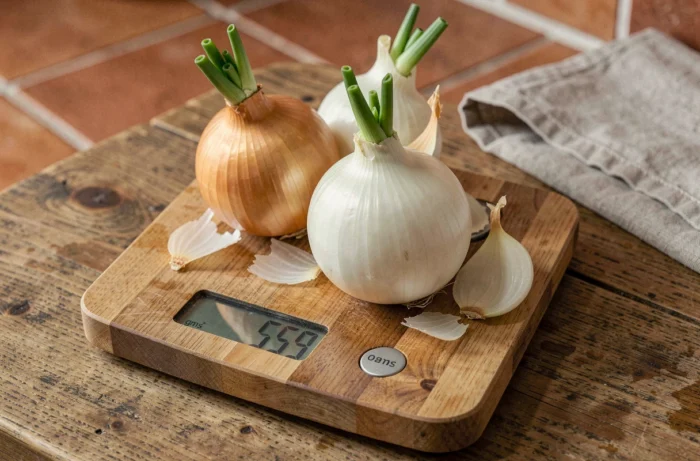
When a recipe calls for “a medium onion,” the actual weight can vary significantly depending on whether you grab a fresh seasonal onion or a dry storage onion. This weight difference affects the proportions of a dish, the amount of juice released during cooking, and even the seasoning measurements. Understanding what distinguishes these two forms allows you to adapt your recipes without approximation.
Onion Water Content: The Factor That Explains Everything
An onion, regardless of its type, is largely composed of water. The dry matter of an onion bulb accounts for about 20 to 22% of its total weight. The rest is water trapped in the layers of the bulb.
When we talk about “fresh” onion (or spring onion), we refer to a bulb harvested before complete maturity, sold with its green stems, without a drying phase. Its moisture content is at its maximum. The “dry” onion, on the other hand, has undergone a drying process after harvest: it is left to dry for several weeks, its outer skins become papery, and it loses a significant portion of its water.
This difference in moisture directly affects the weight on the scale. A fresh onion often appears heavier than a comparable-sized dry onion simply because it carries more water in its tissues.
To know precisely how much an onion weighs in grams, you must first identify which type of onion you are dealing with, then consider its size.
Average Weight of a Fresh Onion and a Dry Onion in Grams
You may have noticed that a fresh onion seems more substantial than a storage yellow onion, even when they have a similar diameter? That’s normal. Here are the useful orders of magnitude in cooking.
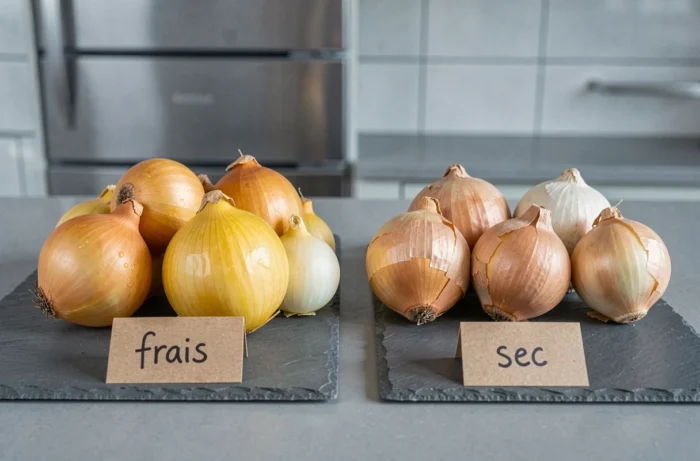
Fresh Onion (Spring Onion)
The fresh onion, sold in bunches in spring and early summer, has a weight that varies according to the size of the bulb. A medium fresh onion generally weighs more than a dry onion of the same diameter, due to its high water content. Smaller fresh bulbs often exceed the expected weight because their layers are filled with juice.
In cooking, this means that a fresh onion releases a lot of liquid during cooking. If you replace a dry onion with a fresh onion in a stir-fry, the result will be moister.
Dry Onion (Storage Onion)
The dry onion, whether yellow, white, or red, has lost some of its water during the drying process. The standard size of a storage dry onion is around 80 g for modern storage varieties. Large yellow onions sold individually in supermarkets exceed this size, while bagged onions may be smaller.
Its flavor is also more concentrated, gram for gram, than that of the fresh onion. Less water means more aromatic compounds per bite.
Fresh Weight to Dry Weight Ratio: The 4 to 1 Rule
When the food industry transforms fresh onions into dehydrated onions (flakes, powder, dried sliced onion), the weight loss is considerable. A fresh onion loses about 75 to 80% of its weight during drying, resulting in a ratio of about 4:1 to 5:1 between fresh weight and dehydrated dry weight.
This ratio pertains to industrial dehydration, not simple agricultural drying. The storage onion sold in bags at the supermarket has not lost as much weight as an onion reduced to flakes. The distinction is useful:
- The storage onion (dry in the common sense) has lost some of its moisture but remains a fresh vegetable for cooking. Its weight has decreased moderately compared to the fresh onion.
- The dehydrated onion (flakes, powder, dried slices) has undergone industrial drying and has lost almost all of its water. It takes four to five times its weight in fresh onion to obtain the same quantity.
- The freeze-dried onion, even lighter, retains flavors better but weighs a tiny fraction of the original bulb.
When a recipe indicates “30 g of dried sliced onion,” it therefore replaces about 120 to 150 g of fresh onion. Conversely, if you only have dehydrated onion on hand, divide the requested fresh onion weight by four or five.
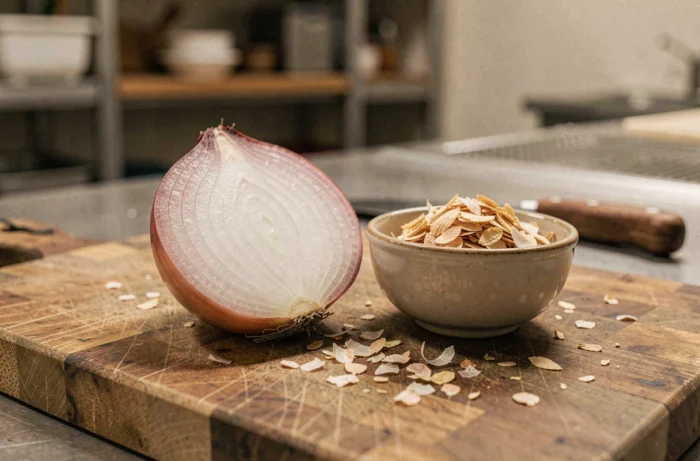
Adapting a Recipe According to the Type of Onion Used
Why does this weight detail really matter? Because the amount of flavor and liquid brought to the dish changes radically.
Replacing a Dry Onion with a Fresh Onion
Increase the amount of fresh onion slightly to compensate for its higher water content. If the recipe calls for a medium dry onion, take a slightly larger fresh onion. Also consider the extra juice: you may need to reduce another liquid in the preparation.
Replacing a Fresh Onion with Dehydrated Onion
The calculation is clearer thanks to the 4:1 ratio. Weigh the fresh onion required, divide by four or five, and measure that amount in flakes or dried slices. Remember to rehydrate the dehydrated onion for a few minutes in warm water before incorporating it, except in stews where the cooking liquid takes care of that.
Points of Caution in Cooking
- The fresh onion has a sweeter and milder flavor than the dry onion. In a dish where the onion needs to add a kick, the yellow storage onion will be more suitable.
- The red onion, whether fresh or dry, adds a slightly different note, sweeter when raw but can brown quickly when cooked.
- Storage also plays a role: a fresh onion lasts a few days in the refrigerator, while a well-stored dry onion in a ventilated place can last several months.
Onion Sizes and Varieties: What Affects Weight
The weight of an onion does not solely depend on its fresh or dry state. The cultivated variety and commercial size come into play. Sweet onions like Cévennes or Roscoff produce bulbs that are often larger than small pearl onions or shallots.
In France, modern storage varieties produce bulbs with an average weight that falls within a fairly homogeneous range, but growing conditions (irrigation, soil, sunlight) create variations. Two onions from the same bag can have significantly different weights.
For recipes that require precision (canning, pickling, measured sauces), weighing the peeled onion remains the most reliable method. Peeling removes the dry skins and the first layer, which reduces the displayed weight by a few grams. It is better to weigh after removing these unusable layers to obtain the actual weight of the flesh.