
Transforming your home involves choosing between purely aesthetic work and renovations that affect the building’s performance. Since September 2026, the framework for financial aid has shifted: MaPrimeRénov’ no longer finances most work by gesture (insulation, windows, ventilation, wood stoves) to focus on heat pumps and the decarbonization of heating.
This refocusing changes the way we conceive an interior transformation project, as it forces a different balance between decoration budget and energy budget.
Home renovation financing: what MaPrimeRénov’ 2026 changes concretely
Decor inspiration articles rarely discuss the financial context. This is a mistake: the “work” item often represents the heaviest part of a transformation project.
| Type of work | Eligible for MaPrimeRénov’ before Sept. 2026 | Eligible since Sept. 2026 |
|---|---|---|
| Insulation (walls, attics, floors) | Yes (gesture-based pathway) | No (except for global renovation) |
| Windows, ventilation | Yes | No |
| Wood stove, insert | Yes | No |
| Thermodynamic water heater | Yes | No |
| Heat pump | Yes | Yes |
| Extensive renovation (gain of 2-3 energy performance classes) | Yes (higher ceilings) | Yes (ceilings lowered to €30,000 excluding tax) |
| Extensive renovation (gain of 3+ energy performance classes) | Yes | Yes (ceiling €40,000 excluding tax) |
The amounts of aid for extensive renovations have significantly decreased compared to previous scales, with reductions reaching around -50% for modest households and up to -80% for higher incomes. The energy sieve exit bonus has also been removed.
In practice, a project that combines interior decoration and wall insulation no longer benefits from the same financial boost as before. Exploring home ideas on News Déco allows you to identify decor approaches that do not depend on subsidized energy components, thus clearly separating the two budgets.
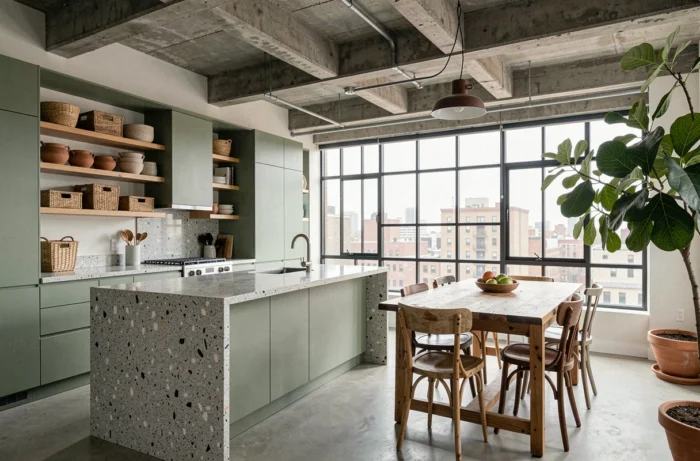
Interior decoration trends that do not depend on public aid
The refocusing of MaPrimeRénov’ encourages distinguishing between two categories of projects: those that strictly pertain to decoration (painting, furniture, layout) and those that affect the building (partitions, floor coverings, woodwork). The former remain free from any regulatory constraints. The latter can become costly without subsidies.
Colors and natural materials as the main lever
Terracotta, light wood, and stone remain reliable values for radically changing the atmosphere of a room. Their advantage: they require no permits, no aid, and their implementation is often accessible through partial self-renovation.
- Light wood (bleached oak, ash, birch) brings brightness without repainting the walls and can be used in shelves, screens, or existing furniture cladding
- Terracotta, in tiles or plaster, transforms a living room or entrance for a moderate cost per square meter compared to a complete floor renovation
- Clay-based plasters naturally regulate indoor humidity, adding a functional benefit to the aesthetic aspect
These materials have one thing in common: they change the perception of a space without touching the structure. This type of transformation remains cost-effective even without public aid.
Multifunctional furniture and vertical layout
Space optimization relies less on tearing down partitions (which sometimes involves a structural engineering firm) and more on furniture designed in volume. Modular storage cubes, seating with integrated storage, or foldable desks allow for gaining several useful square meters without heavy work.
Wall layout, on the other hand, takes advantage of ceiling height. Floating shelves over two meters, combined with indirect lighting, create an impression of volume that costs a fraction of the price of an extension.
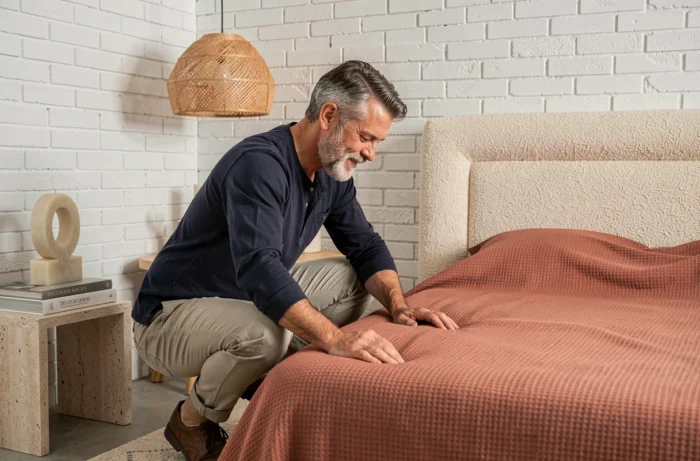
Global renovation vs decoration: balancing your home budget
The classic temptation is to take advantage of a decor project to “add a bit of insulation.” Since September 2026, this strategy has lost its main financial support. Gesture-based work (changing windows, insulating a wall, installing a wood stove) is no longer individually subsidized.
Two scenarios emerge depending on the housing profile:
- For a home rated F or G (energy sieve), the only subsidized path remains extensive renovation with a gain of at least two energy performance classes, which requires a global project supervised by an approved facilitator
- For a home already rated D or better, decoration and layout work are more financially relevant, as the marginal energy gains no longer justify a heavy investment without aid
- In both cases, replacing the heating system with a heat pump remains the only isolated gesture still eligible for MaPrimeRénov’
However, the eco-PTZ remains available to finance certain insulation, VMC, or water heater works that have fallen outside the MaPrimeRénov’ scope. This interest-free loan serves as a bridge for households wanting to combine thermal improvement and aesthetic transformation.
Sustainable design and reused materials: a trend with double benefits
The use of reused materials (reclaimed wood, antique tiles, repurposed industrial metalwork) aligns with a circular economy logic that goes beyond mere fashion. A reclaimed oak floor can sometimes cost less than a new certified parquet, while providing a patina that contemporary design values.
Reuse eliminates the “new raw material” item and reduces the project’s carbon footprint. For a unique interior, it is also the most direct way to obtain pieces that no one else possesses: a workshop door reclaimed from an industrial wasteland will not be found in the neighbor’s catalog.
With the ceilings for eligible aid having decreased, every euro saved on materials frees up budget for skilled labor or purely decorative items (lighting, textiles, paint). The choice between new materials vs reuse becomes a financing lever in its own right in a context where subsidies are becoming scarce for mixed decoration-energy projects.