
The development of a baby does not follow a universal timeline. Each child progresses at their own pace, and the benchmarks provided by health professionals serve as a compass, not a verdict. What matters daily is the quality of interactions, the sensory environment provided, and the parents’ ability to observe without overinterpretation. Supporting a baby’s development is based on a few concrete principles, sometimes less intuitive than they seem.
Screens and Young Children: What French Regulations Say Since 2025
France has tightened its stance on the exposure of young children to screens. Since a decree dated June 27, 2025, published in the Official Journal on July 2, 2025, the national charter for the care of young children formally prohibits any exposure to screens for children under 3 years old in nurseries, micro-nurseries, and with childminders. This ban also covers screens that are on in the background, a point often overlooked.
Since January 2025, the health booklet given to every newborn in France clearly states the recommendation no screens before 3 years old, even in the background. This guideline is now part of routine pediatric follow-up. Parents who regularly consult the Mon Bébé Magique website for babies will find additional resources on alternatives to offer to young children.
This regulatory evolution reflects a growing consensus among pediatricians and cognitive development specialists. However, the available data does not yet allow for precise quantification of the impact of a few minutes of passive exposure per day compared to prolonged exposure. The precautionary principle remains the guiding rule.
Baby Sensory Stimulation: What Really Stimulates the Brain
An infant’s brain develops through interactions with their environment. The most effective developmental toys are not necessarily the most sophisticated. An object with varied textures, a rattle producing a soft sound, skin-to-skin contact with a parent: these simple stimuli activate neural connections far more than digital toys.
Age-Appropriate Sensory Activities
Needs evolve quickly between birth and the first twelve months. Here are the most relevant types of stimulation according to the period:
- From birth to three months: visual stimulation involves strong contrasts (black and white), the parent’s gaze, and physical contact. Motor skills are involuntary, with arms and legs moving in a disordered manner, which is normal.
- From three to six months: the first social smiles appear, and grasping develops. Lightweight, easy-to-grab toys and tummy time on the floor promote gross motor skills.
- From six to twelve months: exploration becomes active. The baby starts to crawl, sometimes standing up. Manipulative play (stacking, transferring) and the first words recognized through imitation nourish both motor and language development.
Nutrition also plays a role in brain development. Introducing solid foods gradually from four to six months, according to pediatric recommendations, provides the necessary nutrients for brain growth.
Body Care and Hygiene: The Gestures That Matter for Baby’s Health
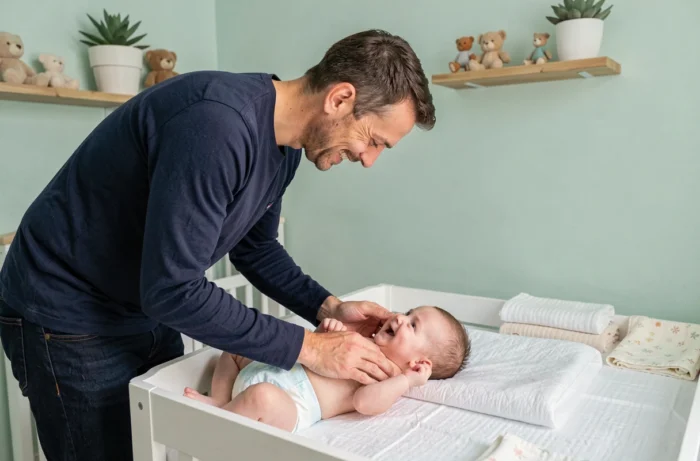
Daily care is not just a matter of hygiene. Bathing, changing, and dressing are special moments of interaction. Every body care routine is an opportunity for communication: talking to the baby during a change, naming body parts, maintaining eye contact. These micro-interactions contribute to language development and a sense of security.
Care Accessories and Bath Water
The temperature of the bath water, the quality of hygiene products, the choice of accessories: these details matter more than one might think. Water that is too hot or too cold disrupts the baby’s sensory comfort and can turn bath time into a source of stress rather than a moment of awakening.
Hygiene products for infants must be formulated to respect the pH of their skin, which is more fragile than that of adults. Field feedback varies on this point: some professionals recommend limiting products as much as possible, including gentle soaps, during the first weeks.
First Steps and Walking: Supporting Without Rushing
The acquisition of walking varies significantly from one child to another. Some babies walk before their first birthday, while others wait several months longer. This variation is not an indicator of delay in most cases.
Walkers (youpala) are discouraged by many pediatricians. They alter the baby’s natural posture and do not promote the learning of balance. Allowing the baby to move freely on the floor, barefoot whenever possible, remains the most widely shared recommendation to encourage autonomous motor skills.
When to Consult a Health Professional
Regular visits to the pediatrician or family doctor allow for monitoring developmental milestones and identifying potential delays. A baby who cannot hold their head up at four months, does not respond to sounds, or does not seek eye contact deserves a thorough evaluation. Regular medical follow-up remains the best tool for early detection.
Advice gathered online or from acquaintances cannot replace personalized medical advice. Each child has their own developmental pace, and the benchmarks are averages, not absolute standards. Supporting your baby daily means first observing, responding to their needs, and providing a stable environment, without trying to rush stages that will come naturally.