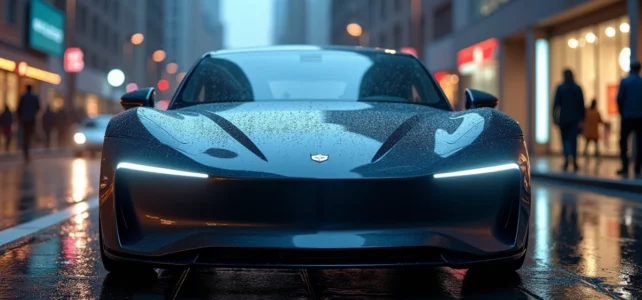
Electric and hybrid vehicles now account for more than half of French automotive production, compared to four out of ten in 2021. This industrial shift, documented by INSEE for 2025, reshuffles the cards across the entire value chain, from technical platforms to charging networks and taxation. Here, we analyze the structuring dynamics shaping the automotive market in 2026.
Bidirectional vehicles and grid injection: V2G technology changes the game
Smart charging goes beyond being a marketing gimmick. Vehicle-to-grid (V2G) technology allows an electric vehicle’s battery to inject electricity back into the grid during peak hours, turning every parked car into a decentralized storage unit.
According to Automobile Propre, this technology could limit massive electricity waste in Europe by smoothing out demand peaks. The principle relies on an onboard bidirectional inverter and a communication protocol between the vehicle, the charging station, and the network operator. Manufacturers that integrate native V2G into their 2026 models offer a concrete selling point: the vehicle’s battery becomes a source of passive income for its owner.
We closely follow the latest auto news on Blog Automobile to gauge the speed of adoption of these architectures among European and Asian manufacturers.
The main hurdle remains the standardization of protocols. Not all chargers yet manage the reverse flow, and buyback rates vary by energy suppliers. For fleet managers, V2G represents a lever for reducing total cost of ownership that goes beyond mere fuel savings.
Chinese brands in Europe: over 10% market share in May 2026
The symbolic threshold has been crossed. Chinese manufacturers exceed 10% market share in Europe for May 2026. This figure marks a competitive shift that mainstream articles underestimate.
Chinese ranges now cover all segments, from city cars to family SUVs, with equipment and finish levels that rival historic brands. The aggressive pricing strategy is based on a vertical mastery of the battery supply chain, from rare earth refining to cell assembly.
For European manufacturers, the response involves three axes:
- Accelerating the deployment of dedicated electric platforms capable of reducing production costs through economies of scale
- Differentiating through embedded software and connected services, an area where the European user experience retains a perceived advantage
- Strengthening intra-European industrial partnerships to secure battery cell supply
The French trade balance for electric vehicles has improved after the downturn of 2023-2024, indicating that domestic production is starting to respond to imported pressure.
Robotaxis and autonomous driving: tests move from the lab to the road
Stellantis, Bolt, and Pony.ai have launched real-world robotaxi tests in Luxembourg. No commercial timeline has been announced, and this is precisely what makes this phase interesting: the challenge is no longer the technological promise but regulatory validation.
The first global rules for fully autonomous vehicles establish common safety requirements and a standardized evaluation methodology. In Switzerland, legislation has allowed certain driverless vehicles since 2025. In Italy, a team of engineers is developing an autonomous vehicle capable of reaching its customer on its own.
These fragmented advances illustrate a reality we observe on the ground: level 4 autonomous driving progresses through regulatory islands, not through mass deployment. Each country or city defines its own framework, which hinders the scaling effect.
Technical inspection and ADAS systems: a new criterion in 2026
Technical inspections are gradually incorporating checks on advanced driver assistance systems (ADAS). A failing autonomous emergency braking system can now lead to a re-inspection. This regulatory evolution forces owners of recent vehicles to keep their sensors and cameras in working order, adding maintenance costs to traditional expenses.
Ecological tax and green taxation: the tightening continues
The 2026 ecological tax scale further lowers the triggering thresholds, both for CO2 emissions and vehicle weight. Heavy thermal SUVs face a double penalty that can amount to several thousand euros at purchase.
For buyers, reading the registration certificate becomes a strategic exercise. The discrepancies in penalties between two engine types of the same model reach levels that steer choices towards plug-in hybrids or pure electric, regardless of ecological convictions.
- The CO2 penalty targets vehicles from the first emission brackets, making diesel and atmospheric gasoline engines increasingly costly to acquire
- The weight penalty targets vehicles exceeding a specific threshold, affecting a growing number of SUVs and high-end sedans
- Electric vehicles remain exempt from both penalties, consolidating their fiscal advantage at purchase
The total cost of ownership of a new thermal vehicle exceeds that of an equivalent electric vehicle across most segments, once the penalties and energy costs are factored into the calculation.
The automotive market of 2026 is structured around regulatory constraints, renewed international competition, and technologies moving from prototype to the daily lives of motorists. V2G, the pressure from Chinese manufacturers, and the gradual framing of autonomous driving shape a sector where purchasing choices rely less on brand preference alone and more on precise technical and fiscal considerations.